Posts

Image
    “Wonderfully Made” When I took a college English course, our first assignment was to write an essay about whether we would rather lose our sight or lose our legs. It was a thought-provoking choice. If we became blind, we would miss seeing our loved ones and all the beauty of our world. If we could not walk, we would be hindered from traveling and moving around without help. I chose to keep my eyesight since I love to read and write and enjoy the variety and beauty that surrounds us.   Of course, I’m glad I didn’t have to make that choice in real life, but it was a thought-provoking assignment. It made me think about how much we take our bodies for granted. I began to think about all the organs, veins, arteries, canals, nerves, and bones we have in our bodies and how they all work together to keep us alive and healthy. It is not until we lose one of them that we realize how magnificent we are, created in the “image and likeness of God.” God loves each and every o...

Image
Becoming a Cheerful Giver In a reflection on the gospel for August 10 (John 12, 24-25), our chaplain offered some suggestions on how to be a cheerful giver like St. Lawrence. According to a legend about this saint, when his persecutors placed him on a fiery grate, he said, “I am done on this side; turn me over and roast the other.”   The homilist suggested that we become like a mop to clean up the spills of others or a pencil, which when sharpened, can be used to help others. These don’t sound very heroic, but they can be a way to be instruments of God’s love. o be used to show how much God loves us.   A mop is such a lowly, mundane thing but useful to clean up messes. Are we willing to be used by God to clean up the messiness around us? To become a pencil willing to be sharpened, to suffer pain for others is another way God can use us. Can you imagine allowing yourself to be like a pencil in God’s hands? I thought of another image to show how God can use us – a piece of...
Image
  Overcoming Discouragement Sometimes discouragement and failure take over our lives, and we cannot seem to crawl out of our hole. Even if in reality they are not a true picture, we can be blinded by the seeming darkness.  It often takes another person to uncover what is hidden from us and to see through the cloudy picture.  I am reminded of a story about Bill Wilson, the founder of Alcoholics Anonymous. He tells of how he felt his dream of starting a group for people with drinking problems was not going anywhere. Then unexpectedly Father Dowling, a disheveled priest, came to his door in the middle of a snowstorm. Bill’s caretaker told him that a “damn bum” was at the door. Bill was tired but agreed to see him and in doing so had his “second conversion experience.” Bil and Father Dowling talked way into the night, and Bill told of his “high hopes and plans, and spoke about his anger, despair and mounting frustrations.”  It turned out that the elderly priest h...
Image
  Everyone Belongs Richard Rohr often speaks of the oneness of things. He emphasizes that everything belongs and everyone belongs. He says that every person is a “holy child of God.” Julian of Norwich, a 14 th century mystic, also speaks of oneness: “The love of God creates in us such a oneing that when it is truly seen, no person can separate themselves from another.”   That sounds good in theory, but I have a hard time seeing certain people as holy children of God, especially corrupt politicians, abusive people, murderers, tyrants, persecutors. etc. I can pray that they will change their evil ways, but how can I love them? Then I begin thinking about my own sinfulness, my own failure to be the kind person I want to be, to be holy.   What if God stopped loving me because I do not measure up to be loving or at least accepting of all? I would be in a miserable state. In fact, I would be in the depths of despair. If everyone belongs, then I have to learn to love ...
Image
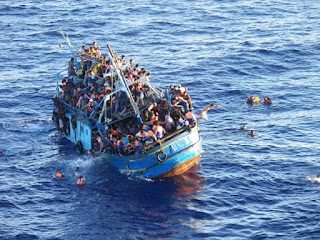
  Boat Tragedy Recently, I read the news story of the Pakistani refugees on the overloaded boat that capsized on the way to Greece. Of the over 700 occupants, only about a hundred survived. Most of the migrants were desperately poor people who were seeking a better life. Of all these tragic victims, one that moved me the most was    a 14-year-old boy whose father had spent all his savings and sold their tiny home to pay for his son’s fare. The father could feed his other children only a scrap of bread once a day. The family had heard of other boys who helped their destitute families by migrating to Greece, getting work, and sending money back home. The boy wanted to do the same. Now the family has nothing, plus they have lost their oldest son. When I read this, sorrow and anger filled my heart. Sorrow for all those who died and anger that such a tragedy could happen.   I’m afraid I was also angry at God for letting this tragedy happen. Yet who can know the mi...
Image
  Can our Planet Survive? Weather patterns are changing around the globe. We hear reports of extreme heat in France, Italy and much of Europe., widespread flooding in Vermont and the Northeast, and high temperatures in Texas and the Southwest. Recent hurricanes have struck in Illinois and Iowa. Environmentalists say these drastic happenings are the result of climate change.   Another sign of climate change is the melting ice sheets which are endangering animals and their habitats as well as our quality of life. Ocean temperatures off the coast of Florida reached 91 degrees last week. Evidence of a warming planet can be seen in natural sources, such as rocks and tree rings, as well as through scientific equipment. Polluted streams, coastal erosion, and forest fires are all attributed to our changing climate. So what can humans do to save our planet and life as we know it? Here’s a start: Eat locally-grown foods, consume less meat and dairy, and shop at farmer’s markets....
Image
  The Genius of the Human Brain Did you know that there are almost the same number of neurons in the brain as there are stars in the Milky Way Galaxy? Each brain cell has several thousand spider-like projections extending out to other brain cells. These projections are called synapses and billions of new ones are created each second in early childhood. Newborns have nearly 100 billion neurons, all they will ever need in their lives.  (See www.onecussion. Com) It is astounding to realize that the neurons in the human brain are as complex and numerous as the stars in our galaxy. No wonder it takes so long to find solutions to the millions of questions and problems facing our world today. We are bombarded with such issues as racism, sexism, wars, human trafficking, and a myriad of diseases. Thank God for the scientists, physicians, and researchers who are trying to find the answers to these challenging issues. As I grow older and my brain begins losing some of those synap...